Blog

Why is Everyone Saying PR Is “Not About the Money”?

Shamara Carney, TriSight Contributor

Any established Public Relations professional will make it a point to warn an entry level associate about the fact that this the field they are entering is not a money business. I know because I have heard the lecture surrounding this issue myself over 10 times since I began my graduate program this fall. “You have to do it because you love it,” says my Introduction to Strategic Public Relations Professor on my second week of classes.

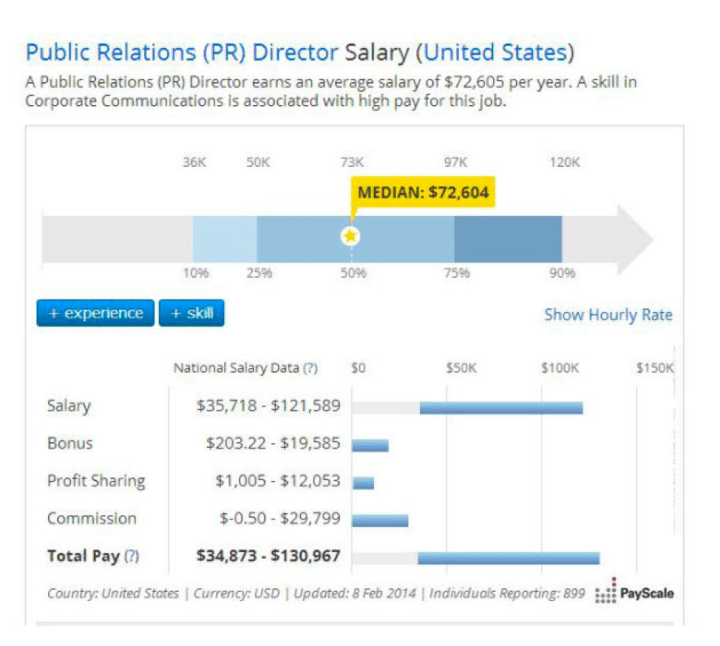
It is not the most comforting message to receive from an extremely accomplish PR professional working at the number one PR graduate university. But, she is right, for a large amount of your career in PR, you will not be paid a tremendous amount of money. In fact, even being positioned at the top of the PR chain as a Director your average salary would be a modest $72,605 per year as shown in the graph below.
Picture1Despite all of this, I still have a burning desire to become involved in the field of Public Relations. Because it is more than just a job, it is a lifestyle. For so long, I did not realize that I had the perfect personality for PR because I had no idea what the field consisted of. I simply thought of publicity when I heard the name because that is what it is portrayed as on television. But, it goes beyond that. PR involves storytelling and creativity with words which, I discovered over the course of my life, was what I loved to do.

Recently, with the high dependence on social media somewhat plaguing our society, PR has moved past traditional storytelling. Professionals in this field must now adapt to the instantaneous changes that occur as a result of this transition by fully engaging themselves into it. It makes me even more excited about the field because I find myself becoming bored so easily and in PR, there is no way that can happen.

Chief corporate recruiter of Sword and the Script, a PR publication, stated “PR isn’t like accounting, you don’t just show up at 9 a.m. and work on a spreadsheet until five. PR professionals are the hub of their organization’s social graph and social media never sleeps.”

So, yeah, the salary may seem like a reason to back away from the field but I most definitely believe that there are many rewards beyond the money. It is not like any other job you may receive and it is completely unpredictable. Those reasons alone make up for about $20,000.


 

Finding Your Creative Edge

Chelsea Jones,TriSight Contributor

Bogged down with reading materials? Papers? Maybe your job? Your everyday life can become a bit overwhelming and you don’t have enough brain power remaining to create some magic. Public relations demands for creativity on many levels, whether it’s critical thinking or creating content. So how do you maintain your existence as a magical unicorn and feed your imagination?

According to Inc.com, here are a few tips:

  1. Get off the internet. So much time is spent behind your phone, you’re missing out on inspiration that can be found in your surrounding environment.

  2. Make a list of 50 things to do. ALONE! Eliminate the possibility of other people criticizing your way of thinking. Sometimes it is appreciated, but it’s not always necessary.

  3. Immerse yourself in a different culture from your own. Draw from the sounds, feels and tastes of other cultures allowing you to cultivate diversity within your work.

  4. Take an improvisation class. Get a little crazy and force yourself out of your comfort zone. Improving will strengthen your ability to think on your feet. Remember, pressure makes diamonds.

  5. Meditate. Meditate. Researchers have found this to be a helpful practice and it only requires 12 minutes of your time. Quite relaxing, this method of focusing increases creativity through repetitive breathing techniques. Namaste every day.

  6. Take a nap. Kids have the wildest imaginations and it’s most likely due to the fact that they’re able to nap. Adults deserve this same leisure. Put your mind at ease and catch a couple of z’s. If you’re caught sleeping at work, just kindly say researchers have proven naps are needed for learning and creativity purposes.

Personal Branding on Social Media

Hillary Thompson,TriSight Contributor

Social Media is now a rolling resume of your accomplishes and employers are looking to it for insights into your life that they won’t get from your traditional resume. Being aware that this is how you will market yourself, it’s important to brand yourself as successfully as possible. Here are a few tips:

  1. Keep track of all your social media profiles. This will make you are aware of all of the different places people can (and will) find you. If there is a specific account that you are no longer using deactivate or delete it. Make sure that your information and profile photos are consistent across platforms because it makes it easier for people to be sure they have found the right person! And, update your information frequently so it’s always current.
  2. You don’t need multiple accounts. People tend to think they should keep their business and personal pages separate so they create a secondary account for their personal information. In today’s social media driven world it makes better sense to compile them into one account because you are your brand and you want your personality associated with everything you do! Also, because social media is so readily available it is confusing if someone searches for you and comes across multiple profiles. If you are concerned about posting something that might offend someone it might be better to not post that particular item at all.
  3. Pick 1 to 3 areas of expertise and go all in. When anyone (a friend, potential employer, or complete stranger) comes across your profile it should be very clear what you do that you are good at. This will help you in all sorts of ways. If a potential employer sees it they will know right away that these are your strengths. If a friend knows that you are good at specific things they’ll be more likely to remember you when they hear someone is looking for that specific characteristic. And if a complete stranger stumbles upon your instagram and sees that you are a SEO wizard they might just reach out and ask you to help them with their website.

These three tips should help you get started on building your own personal brand. You are your first and best advocate so get out there and blow everyone away!

Screen Shot 2018-10-24 at 8.59.59 AM

Sociable person and social responsibility

Jason Lu,TriSight Contributor

I’m turning 24 Tuesday. As of a twelve-year cycle, it’s my zodiac year of birth again. At this age, most of my peers back in China are stepping into the career life for the first or second year. Getting rid of the immature self in campus, many are forcing themselves to fit in the workplace for such a big role transition. I’ve heard that one alumna of my high school resigned from a top-tier consulting company after one year’s work, due to poor personal relation with her supervisor.

It’s true that interpersonal communication is important in our everyday life, especially for the professional one. Chinese universities, except for the business schools, barely have any career related social events for undergraduates to get in touch with industry leaders. A born sociable person, or an experienced trainee, will stand out in job performance. It’s not just about interacting with other people, but responding with the society, which is typically made up of human relation.

Though we are now in a stage of advocating gender equality, given the circumstance where I grew up with, males are more intentionally taught about the behavior in social occasions, even for a young boy. More social responsibility has burdened urban men. One example of my personal experience, especially during teenage time, is about the table manners. Since my father has considered me as a half-grownup, he started to teach me about how to engage in dialogue with elders and frequently encouraged me to propose a toast in the presence of everyone. I was quite embarrassed then, didn’t see it useful for my adolescence. Every time when I stood up and squeezed words from my mouth was a big torture.

After years of touch with people on campus, at workplace, or in the society, I’ve gradually realized the practice during my rebellious age has made me a more sociable person, I’m always intrigued in participating social activities. Walking out of my comfort zone has actually challenged my limit. Now I understand my father, this custom reflects his social responsibility as a father to educate his son. And it’s my turn to pass on the communication, a huge task for a 24-year-old guy.

5 REASONS GRADUATE SCHOOL IS THE ABSOLUTE WORST

 Jenna Perlmutter,TriSight Contributor

Picture1

  1. IT’S BASICALLY LIKE RELIVING YOUR COLLEGE DAYS EXCEPT IN A FIELD YOU ACTUALLY CARE ABOUT
    Grad school cuts right to the chase. You’re not required to take the ‘fluff’ GenEd classes you had to take in your undergrad. Instead, your program offers classes that are in the realm of your interests. Yes, there is plenty of homework and readings but it’s not nearly as dreadful as
    undergrad because you’re mastering the skills in a field that you’re passionate about. You’re paying to learn about a topic from esteemed professionals that genuinely want you to succeed.


  1. YOU CAN PROLONG DECIDING WHAT YOU WANT TO DO WITH YOUR LIFE
    Whoever graduates from college knowing exactly what they want to do in their life cannot be trusted. Sure, there are many exciting jobs and opportunities out there but it takes working for a few different jobs to truly learn what you do and
    don’t enjoy doing. Grad school prolongs that looming pressure you feel post grad when your family asks what you’re doing with your life. It’s also a wonderful time to take advantage of the classes your university offers that you didn’t have time to take in your undergrad.


  1. YOU SOCIAL CIRCLE EXPANDS
    Let’s be honest. College was a great time to dabble in clubs, intramurals, Greek Life and socialize in class. But six months
    post grad, you’re likely only keeping in touch with a handful of people, which is totally okay because those are the friends you foresee in your wedding one day. In grad school, you’re surrounded by like-minded individuals that are also willing to put the time in to become successful. Your classmates understand all too well the challenges of balancing a busy schedule and the daily contemplation of going to bed by 9p.m.


  1. GRADES DON’T MATTER
    Unless you plan on continuing your education to earn a
    PhD, grades in graduate school don’t really matter. Don’t get me wrong, it’s important to at least maintain the university’s minimum GPA requirement, but it’s more important to focus on getting to know your classmates and networking with your professors. The post-grad job market is highly competitive and employers are not interested in the GPA you maintained throughout graduate school. You probably heard it all the time in your undergrad, but network, network and network. Your professors are well connected in the industry and are likely to connect you with the right people.


  1. YOU’RE INVESTING IN YOUR FUTURE
    While your friends are busy working full-time and earning a steady salary, you’re dedicated to being a student. Some students procure internships or part-time jobs during their program while others commit to being full-time students. Either way, it’s nearly impossible to work a full-time job and you can feel like you’re “behind” compared to your friends that have a regular paycheck coming in. However, investing a few short years to earning a master’s degree sets you up for success for the rest of your life. Upon matriculation, your degree sets you apart in the job market and you always have an advanced degree to fall back on. Not to mention a strong alumni network for life.