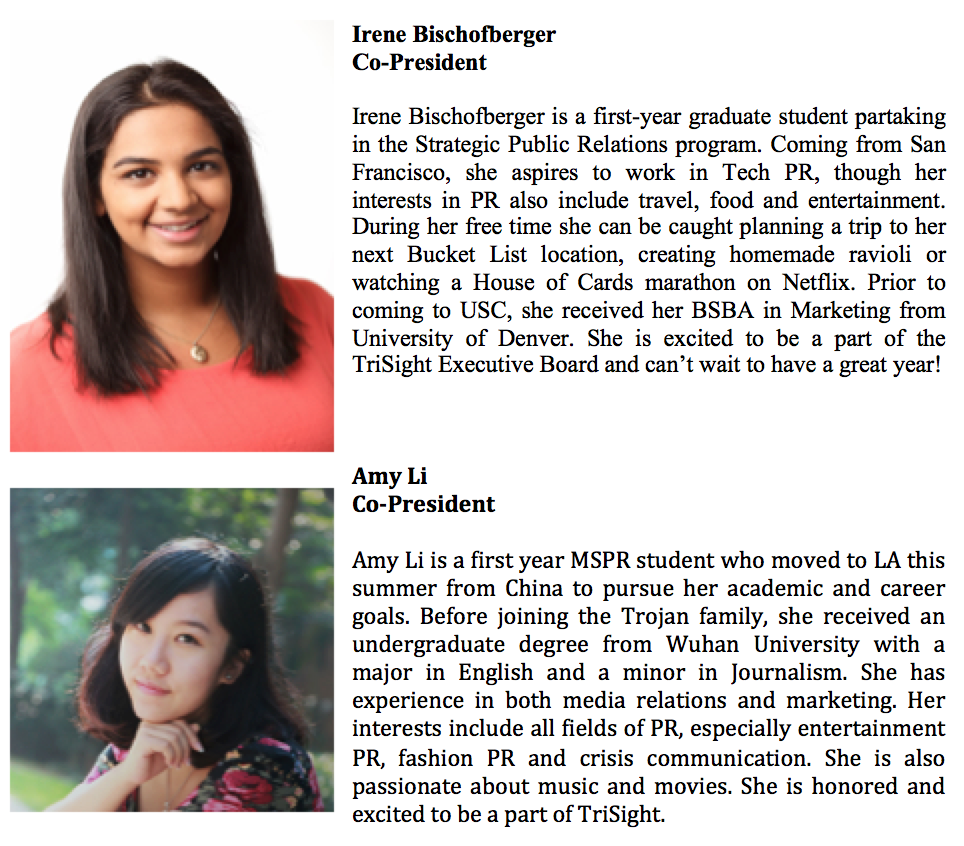
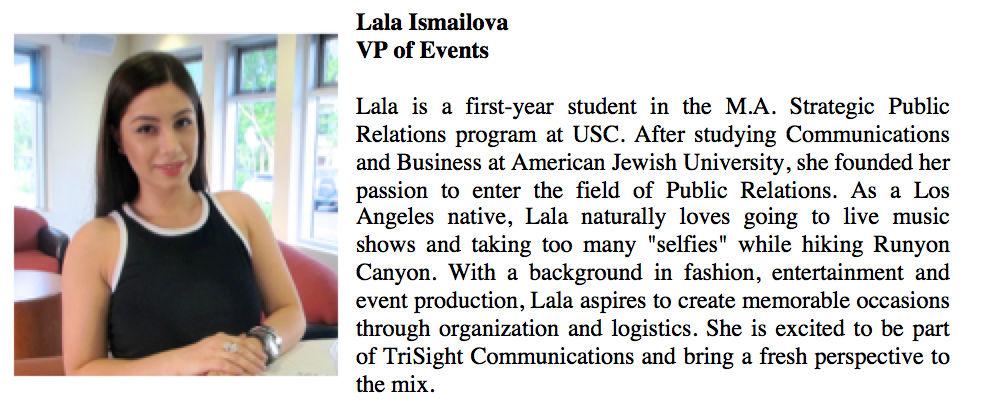
The TriSight Communications Executive Board for 2016 has been selected and it is with great pleasure that we introduce them to you!


TriSight Communications
The TriSight Communications Executive Board for 2016 has been selected and it is with great pleasure that we introduce them to you!
There’s a time and a place for everything, the old idiom reads.
Well, that time should be always, and that place should be everywhere.
I’m talking about grammar and its nauseating misuse among our generation.
Now, I’ll admit I’m a bit of a grammar policeman. Proofreading is legitimately one of my favorite PR-related tasks. One might even say I have a flair for the … grammatic. (Sorry, I’ll stop with the terrible puns.)
Regardless of your passion level for accurate grammar, however, you must understand its importance, especially in the PR/marketing/communication industry.
I’m not going to use this space to walk through correct punctuation or discuss my opinions on controversial usage like the Oxford comma (which I vehemently oppose). You’re all bright students who have constructed enough sentences correctly to perform at the college level.
Instead, I want to emphasize the significance of proofreading and hopefully inspire you to re-read your next written assignment just one more time.
Here are some reasons to #checkyourgrammar:
Credibility: Probably the most consequential reason to #checkyourgrammar is to establish trust between you and your audience. In many of your PR classes, you’ll hear professors preach about recognizing a brand’s audiences and prioritizing stakeholders. What’s great about sharp grammar is that it’s effective for any and all audiences. Sure, slang will prove to be useful on social media to attract the younger generation, but even then, conscious grammar decisions go a long way in supporting a brand’s communication efforts.
Resume building: Wondering why you’re not receiving calls from potential employers after submitting an application? Take a harder look at your resume. Multiple HR directors have told me that grammar mistakes are just about the easiest way to have your resume end up in the trash. If you can’t find the time to polish one of the most valuable documents in your life, how can an organization expect you to professionally organize your thoughts on behalf of their brand?
Satisfaction: Maybe it’s just me, but doesn’t it feel fantastic when you turn in an assignment and have no qualms about getting dinged for sloppy work? Conversely, I loathe that feeling of knowing I made sound arguments, but nothing in life matters anymore because I left a dangling modifier in the second paragraph.
The knowledge is there: It’s not as if this is a skill set you don’t already have. You already understand the difference between a dependent and independent clause. You know when to use lay and when to use lie. You’re doing yourself a disservice if you don’t take advantage of your understanding of the language.
You can’t rely solely on spell check: I hate to break it to you, but Microsoft Word’s spell check function doesn’t catch it all. Spell check is the Google Maps of grammar fixers. It’ll get you close to where you want to go, but sometimes it’ll leave you hanging around the corner from your destination. Before you hit submit, you need to give it one final read. Put yourself in the shoes of a word like affect. Affect is a verb (except for its psychology-based definition), an emotional one at that, and people hurt its feelings when they use it as a noun. You wouldn’t want to be called Jack if your name was Jake, would you? Think about that the next time you don’t think you need to proofread.
If not for yourself, then proofread for the sake of the beautiful English language!

Written by Lukia Yuanshu Xu
Storytelling has always been a center of PR and marketing, in fact, it is sometimes more important to a business than the product or service. A well-crafted and visually appealing story could help your business catch the attention of customers, but to further convince your audience, you will need to build some credibility with data.
Being a data-driven storyteller is not just for content marketers, but for nearly everyone who needs to present to clients, superiors and even just in class. The numbers always speak for themselves.
To be a data-driven storyteller you don’t need a degree in statistics or be a maven in data analytics, as someone whose job is to tell the story, you just need to know how to interpret and present the data in a right way. So here are some tips of becoming a savvy data-driven storyteller and some resources you can use, mostly free.
Like all marketing/PR campaigns, you always want to keep audience on the top of your mind. Make sure you know what their “pain points” are and how your products/services could speak to their needs. Your goal at this stage is to come up with a question that your story will address. If your question has a quantifiable dimension, it is more likely to make up for a good data-driven story.
By “right data” I’m not just talking about the data that make your story compelling, but the data that are credible and solid enough to convince your toughest client. That means you need to be careful about the sources of data, Wikipedia is not allowed as data source in thesis for a reason.
If you want credible data, here is a list of some common sources:
If good data make up 40% of a successful story, then visualization is 60%. Human beings are visual animals, especially in this world full of distractions, people will only pay attention to the catchy ones.
Using infographics is a good way to convey your message. The longer layout allows one to actually tell a story from the beginning to the end, keeping your audience on hook before getting bored of all the numbers.
Some tools to generate infographics are: Adobe Illustrator, Powerpoint/Keynote, and online websites like infogr.am. If you like design or holds very high standard to your work, Illustrator would work to your best interest, it just takes more time to learn. If you don’t mind using other people’s design, online websites would be your go-to place. Personally I like Powerpoint, because it’s just so easy to use and also allows great room for creativity. A lot of designers actually use Powerpoint frequently. You can get Illustrator for free if you are from Annenberg, and most of the templates on infogr.am are free while some do cost a bit money.
An interesting way to present the data would be interactive, this works well for audiences who like to explore a bit, and honestly who wouldn’t like to play a little game? A software to help you realize this would be Tableau. I call it a “fancy Excel” because all you need to do is put your data in and choose a chart/graph. It works well even on large quantity of data, like thousands of tuples. And you can get a free student version on their website, otherwise it’s very expensive for entreprises.
With your USC account, you can take the courses on Lynda.com for free to learn these tools.
This sounds like cliche but a lot people will forget when they actually start working. You get excited about your beautiful masterpiece and you can’t wait to show it off to everyone. But before you do anything, be aware that you are too small a sample and your opinion is highly biased. Ask someone else for their thoughts, especially those similar to your audience, have a keen eye for design or have done this before, they might tell you this color should be lighter, that portions on the pie chart don’t match with the numbers, or it’s just not that interesting to catch attention. They will save you a lot of trouble and frustration.

There is clearly no doubt that internships are valuable and will, most likely, land you a job. Being an intern can be stressful and making an impression is not always easy but here is a list of things you should keep in mind while interning. If your internship does not lead to a job, it is always useful to leave with great recommendations, referrals and connections that you may need in the future.
It may seem silly but being late, especially on your first day, leaves a terrible impression from the start. Being early is a sign of respect and it just shows you are ready to work and be productive. So set that alarm and keep in mind it’s always better to be early than late!
It’s important to complete your assigned tasks in a timely manner. To be safe, always make sure to ask for a deadline so you can plan accordingly. Once you are done, don’t sit at your desk doing nothing or checking out your phone. Instead reach out to your co-workers/managers and let me know you are free to work on a new project.
If you don’t know, well … you don’t know. There is nothing worse than pretending that you know and not asking. It may get you stuck in your work or even fail. Instead, you should feel free to ask questions. Not only does it show that you want to do the right thing but it also emphasizes your interest and it just prevents making mistakes. Your manager will most likely love helping you out and giving you advice. You will feel less stressed and in the meantime, you get to learn even more!
In the world of communication, multi-tasking is a big thing and it can quickly feel overwhelming. Being organized should be your top priority to stay on track. Feel free to have a planner or a calendar that helps you identify your daily and weekly projects. Don’t forget to set deadlines! This way, you know what to focus on. Don’t waste time on a task that is due in two weeks if you have something due by tomorrow morning.
Of course companies are looking for brilliant, smart interns but your attitude has a lot to do with how your co-workers and managers perceive you. If you bring a positive attitude to the office and your willingness to help and alleviate some of your coworkers’ work, they will most likely be grateful. If you bring a negative attitude by being overly critical and demanding, you may leave a bad impression and that’s not what you are looking for.
Your very last week as an intern, it is wise to let everyone know you are leaving soon and you are ready to take on any last project they may need you to work on. The more valuable and available you make yourself, the harder it will be for them to see you go. On your very last day you should be ready to thank everyone for the opportunity you’ve had and give them positive feedback on your experience.
Keep in touch with your co-workers and managers. You never know if you might need their help or referrals in the future. Feel free to ask them for a LinkedIn recommendation. If you have done a good job, they will be more than happy to do it for you.
If your internship was not what you expected, try to be positive about it and learn from it. It is always disappointing but … hey, it’s just one internship! The next one will be better. Be careful not to publicly criticize the company or your coworkers, even if you had that awful, micromanaging boss that no one likes. It’s a small world we live in and you certainly don’t want the wrong person to hear your negative comments. You should be careful whom you give negative feedback to.
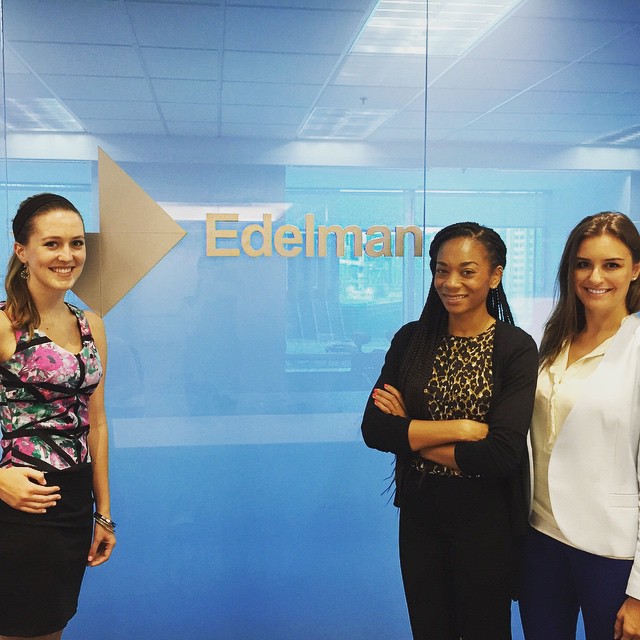
This past summer, I took advantage of Annenberg’s International Program and interned at Edelman’s Hong Kong office. Having never traveled to Asia before, I was immensely excited (and nervous) for the opportunity.
As a leading firm in the industry, Edelman had always been high on my list of places to apply for work experience. Better yet, the program offered the unique chance to learn and operate in a culture completely foreign to me. I wondered if Twitter would be as ubiquitous or if Kimmy K’s name would have any sway on product promotion.
Upon arriving in Hong Kong, I was astounded by the harbor’s skyline and the deliciousness of the street-served barbecue pork. I had never seen a city that is such a blend of modernity and custom – where western influences are very obvious in building structures, but traditional Chinese culture continues to flow through the streets.
I was assigned to Edelman’s Digital Practice Team. My day-to-day tasks included scanning the web to find and create relevant written and multimedia content for client’s social media pages; writing and reviewing content calendars and compiling reports detailing engagement on client’s Facebook pages.
One of the most exciting and educational projects I worked on was for Tencent. If – like me – you haven’t heard of Tencent, it is a significantly large holding company in China that owns social media platforms Weibo, WeChat and one of the largest web portals in China. Due to its prominent position in China and its continuous innovation, it is currently one of the largest Internet companies in the world and definitely a force to be reckoned with. The Technology, Digital Practice and Studio X teams were preparing SY Lau – President of Tencent’s Online Media Group – for his acceptance speech at the Cannes Lions International Festival of Creativity. Knowing very little about the company, I heavily researched everything online and in Edelman’s archives to attempt to draft press releases for the event. After displaying interest in video editing, the Studio X Team started to give me more responsibility in creating basic edits of internationally influential figures congratulating SY Lau. My edits were sent to the client and they selected the parts they wanted the Studio X Team to use in the promotional video that would play during the acceptance speech. It was such an honor to be part of the creative process – and though I can’t take any credit for the incredible final video they produced, it was an invaluable learning experience.
Another project that I really enjoyed and benefited from was the creation of a social media playbook for a Chinese technology company. By creating a set of guidelines, I gave recommendations to how they should conduct themselves on social media. I researched and scored all of their international social media pages and concluded that the main problem was inconsistency in content. I suggested a brand voice, tone and the language that should be implemented universally and created four content pillars for them to base their posts around. I also advised that images and videos should cohere with the same set of rules so that their audience could navigate seamlessly across all pages.
The experience taught me so much and far exceeded my expectations – both in terms of career development and cultural understanding. To anyone who is considering the program – I would absolutely recommend it. However, words can only say so much, so, in true digital fashion, I will finish off with a video I made compiling my Hong Kong memories (apologies for the unsteady camera holding!).
https://www.youtube.com/watch?v=tZTyD1MNqtc
 T R I S I G H T