Key Takeaways from the 2019 Relevance Report

Erin Brown, TriSight Contributor

The USC Center for Public Relations publishes a Relevance Report each year to forecast emerging trends and issues that will impact society, business and communication. The 2019 report contains thought pieces from communication leaders at companies such as Hyundai, Nintendo, Edelman, Ogilvy, Golin and MSL.

On Thursday, November 1, the USC Annenberg School for Communication and Journalism hosted a PR Future Speaker Series to introduce the 2019 report. Moderated by Fred Cook, the director of the USC Center for Public Relations, the panel event highlighted trends found by eight of the contributors to this year’s Relevance Report.

Here are a few key takeaways from the event:

  1. Large tech innovations are happening outside of the United States, particularly in Asia, and driving market changes. As the U.S. becomes more internally focused, Asian marketplaces are filling the void.
  2. Social media has made companies increasingly susceptible to crises. By proactively conducting internal audits, companies can identify vulnerabilities before they become crises and prepare communication plans accordingly.
  3. The PESO model – paid, earned, shared and owned – is converging on itself. Changes in technology facilitating this convergence have also allowed anyone to become influencers. Brands need to select influencers who will effectively reach the desired target audience; influencers need to select brand deals with authenticity and clearly communicate when content is sponsored.
  4. As “Generation Z” grows in purchasing power, retailers need to change approaches to marketing and the consumer experience. Generation Z expects equality in representation and corporate social responsibility (CSR) practices as a baseline for all businesses.

For more information, download the full 2019 Relevance Report here.

Finding the Right Influencers for Your Brand

Katherine Butler, TriSight Contributor

By now we all know that the rise of social media has completely transformed the world of PR. There is no doubt a brand’s social media presence (or lack thereof) has the power to take a company to new heights. Strategically choosing the “right” influencers to partner with creates the potential to improve your brand’s reach and reputation. However, working with the “wrong” influencers can harm a brand’s credibility, create distrust, and ultimately waste time and money.

What steps are you taking to ensure you are working with influencers that will help your brand achieve its goals? Here are the top 5 factors to consider when searching for influencers to collaborate with your brand.

  1. Identify your brand’s ideal influencer industry.
    There are countless influencer marketing niches, and your brand might fall into several categories depending on your goals. Think fashion, travel, sports, gaming, parenting, business or tech to name just a few. Once you establish your influencer industry, you can begin to research which social media accounts rule your sector.
  2. Look for influencers who visually align with your brand.
    How appealing is an influencer’s profile feed? Especially on Instagram, make sure to choose influencers who have a cohesive Instagram aesthetic that aligns to your brand’s image.
  3. Beware of fake followings.
    It is not uncommon for people to purchase followers and likes through Instagram bots and other unethical services. Be on the lookout for unusual “followers to likes ratio” and read the comments on posts to see if followers are genuinely engaging with the person. Tools like Social Blade can also detect sudden drastic increases in followers, another sign of purchased followers.
  4. Monitor influencer’s post to make sure they are staying consistent with your brand’s values.
    Follow-up on the influencer – and not just the posts specific to your brand. Sometimes an influencer’s personal life impacts their image, online or offline. Do your research before and after partnering and continue to ask, “Is this a person my brand wants to be connected with?”
  5. Consider an influencer’s authenticity.
    Nowadays, the most impactful influencers are those who are unfiltered, vulnerable, and who ultimately treat their audience like a close friend. Check out the influencer’s feed. Do they only post about collaborations? Do they feel too promotional? How much of their personal life do they share?

“How I’m Guided as a Starting Photographer”

“How I’m Guided as a Starting Photographer”

Elements that propel my work

I recently purchased my very first camera: a Canon Rebel series T6 with a 50mm lens.  For starting photographers, I definitely recommend this combination because both are very user friendly and have great automatic settings for those still learning how to balance shutter speed and such.  Although I’ve been taking photos with friends’ cameras for years, it wasn’t until this year that I purchased my own.  My reason being was that I told myself I wouldn’t spend the money on a camera until I knew my vision as a photographer, worked with natural lighting until I knew the sun like I know the inside of my hometown Walmart, and knew the best angles of any person.  I spent years practicing how to capture a diversity in body shapes in a way that accented the beauty in each.  My best friends were my iPhone, golden hour and Grace (my hometown best friend who also let me borrow her camera often).  The first thing to grasp before taking photos is lighting, and personally I find natural lighting to be the most stunning and rewarding.

When it comes to lighting, you need to know what’s too much light and not enough.  The best times to shoot is 25 minutes after sunrise and 25 minutes before sun down, both known as golden hour.  Too much light can result in unflattering shadows, saturation and loss of natural face angles.  Little light + taking a picture = low quality, less detailed photos.  In good lighting, one can take a much better picture on an iPhone than with a professional camera in poor lighting.  There are more basics to photography like composition, framing and editing, but I’m going to talk about what has guided me as a photographer into producing content I’m really proud of.

For me personally, I don’t like to shoot something without having an intention or narrative behind the photos.  I work as a stylist as well, so when I’m selecting the looks, I build a narrative in my head to motivate me as a photographer while on set.  Having a specific vision in mind allows for a special click to happen in my mind during shooting.  If I know the story that I’m trying to convey, then the pictures will stand out immediately with an illumination of the message.  Knowing the model well isn’t necessary, but there’s a certain magic that happens that you both get to experience together during the process that’s unmatched.  I usually dress the models I work with in my own clothing as well which carries a layer of familiarity and metamorphosis at the same time, making the end result that much more personal and rewarding. Recently I worked with a singer and LGBTQ activist who’s a student at the University of Southern California.  Below is my series named after him: LINNEL

Another way I find depth within a shoot is giving myself specific elements that I want to elucidate.  This basically supplements the narrative for me, so I do this when I am wanting to go broader with my images’ context.  My most recent photoshoot I orchestrated in this way was with a younger actor and athlete from USC named Jet Mendes.  We both took an acting class on scene studies, so for some of the classes, we were required to come in costume.  As a result, people would be rushing from class in traditional 30s womenswear.  For Jet’s scenes, he had to wear a suit, but since he was skating from his apartment off campus, he would be sporting vans with the look.  Although unintentional, the blend of aesthetics worked, and after he asked me to take digitals for him, I knew the elements I wanted to incorporate in the set, wardrobe and photography style.

STREET SKATE | FORMAL | ATHLETIC

The most helpful factors thus far have been working with people who inspire me as an artist and pushing myself to photograph as much as possible.  Keeping my work threaded and constant propels me the most, so that’s the biggest advice I can give alongside finding your vision.

Laura Montilla
PR Specialist | Stylist | Artist
lmontill@usc.edu

Blurred Lines: Payola & Native Advertisements

By Cathy Park, TriSight Contributor

In academic and theoretical approaches, public relations is centered around the ‘PESO’ model. The PESO model refers to the paid, earned, shared, and owned media channels in which organizations can disseminate content.Picture1.png

Image Credits: SpinSucks.com

Usually, it is the strategic combination of these media channels that makes for successful campaigns. Historically, the notion of public relations focused merely on the “earned” portion of this model–specifically obtaining journalistic coverage. However, public relations, as we know it today, is an ever-changing field that has adapted so that earned media now only represents only a small portion of a practitioner’s job.

The dynamic nature of today’s media sphere is generally viewed as a positive attribute. Brands can interact more directly with consumers and the public due to social media channels, and multiple platforms allows for integrated messaging that incorporates more creativity than ever before.

However, even with these newfound benefits, there are new ethical implications that must be addressed. More and more, we see the lines between paid media and earned media blurring.

It is a common practice for journalists or bloggers to cover content that they have been paid to write about. However, the ethical dilemma comes from the fact that many of the articles do not blatantly state that the content has been crafted for advertising purposes.

This has historically been a problem, specifically in the music business. “Payola” refers to when record labels pay radio stations to promote their artists’ music by playing their songs more frequently. According to the Federal Communications Commission, stations must disclose whether or not they are being paid to promote any type of content.

The new media terrain has allowed for this problem to surface on other platforms, particularly news websites, blogs, and social media sites. Native advertising is the use of paid content in a format that looks and seems like a typical ‘earned’ news article. To combat these growing practices, the FCC announced a similar set of rules for bloggers and journalists in 2010. They must let their readers and followers know whether or not their endorsements have been paid for.

However, this is not always a rule that is closely followed. And even with these rules in place, how will the FCC actually be able to monitor who complies and who does not? With the millions of bloggers, writers, and reporters out there, can the FCC actually enforce these guidelines? Not really.

Image Credit: AOL.com, VanityFair.com

It is becoming increasingly difficult for readers to decipher between what is, as earned content is more valuable to companies than paid content is. With shorter attention spans and increasingly adverse attitudes toward paid advertisements, audiences clearly favor organic content. Therefore, many companies may actually opt to pay more for influencers and journalists to conceal the pay behind the content. To combat these seemingly blurred lines, platforms like Instagram have specific ways that influencers should be disclosing of ad content to their followers.

Image Credits: Instagram.com

Public relations is field that is consistently growing and has much promise for corporations in the future. However, with these bribing practices, it seems like the focus on the perspectives and rights of the audience are dwindling, as corporations and media professionals take the upper hand. For PR professionals entering into this arena, it is important to remember a balance between what the public deserves to know and what companies and corporations can do. Even with these the fast-paced changes brought on by the modern, multi-faceted media terrain, ethics must be prioritized if PR should remain a reputable and respected field of work in the long run.

 

Why is Everyone Saying PR Is “Not About the Money”?

Shamara Carney, TriSight Contributor

Any established Public Relations professional will make it a point to warn an entry level associate about the fact that this the field they are entering is not a money business. I know because I have heard the lecture surrounding this issue myself over 10 times since I began my graduate program this fall. “You have to do it because you love it,” says my Introduction to Strategic Public Relations Professor on my second week of classes.

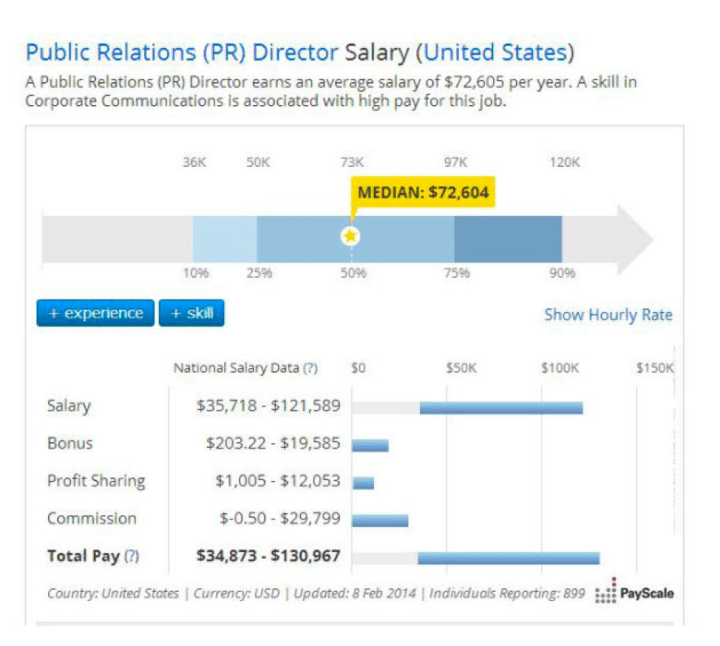
It is not the most comforting message to receive from an extremely accomplish PR professional working at the number one PR graduate university. But, she is right, for a large amount of your career in PR, you will not be paid a tremendous amount of money. In fact, even being positioned at the top of the PR chain as a Director your average salary would be a modest $72,605 per year as shown in the graph below.

Picture1Despite all of this, I still have a burning desire to become involved in the field of Public Relations. Because it is more than just a job, it is a lifestyle. For so long, I did not realize that I had the perfect personality for PR because I had no idea what the field consisted of. I simply thought of publicity when I heard the name because that is what it is portrayed as on television. But, it goes beyond that. PR involves storytelling and creativity with words which, I discovered over the course of my life, was what I loved to do.

Recently, with the high dependence on social media somewhat plaguing our society, PR has moved past traditional storytelling. Professionals in this field must now adapt to the instantaneous changes that occur as a result of this transition by fully engaging themselves into it. It makes me even more excited about the field because I find myself becoming bored so easily and in PR, there is no way that can happen.

Chief corporate recruiter of Sword and the Script, a PR publication, stated “PR isn’t like accounting, you don’t just show up at 9 a.m. and work on a spreadsheet until five. PR professionals are the hub of their organization’s social graph and social media never sleeps.”

So, yeah, the salary may seem like a reason to back away from the field but I most definitely believe that there are many rewards beyond the money. It is not like any other job you may receive and it is completely unpredictable. Those reasons alone make up for about $20,000.