Personal Branding on Social Media

Hillary Thompson,TriSight Contributor

Social Media is now a rolling resume of your accomplishes and employers are looking to it for insights into your life that they won’t get from your traditional resume. Being aware that this is how you will market yourself, it’s important to brand yourself as successfully as possible. Here are a few tips:

  1. Keep track of all your social media profiles. This will make you are aware of all of the different places people can (and will) find you. If there is a specific account that you are no longer using deactivate or delete it. Make sure that your information and profile photos are consistent across platforms because it makes it easier for people to be sure they have found the right person! And, update your information frequently so it’s always current.
  2. You don’t need multiple accounts. People tend to think they should keep their business and personal pages separate so they create a secondary account for their personal information. In today’s social media driven world it makes better sense to compile them into one account because you are your brand and you want your personality associated with everything you do! Also, because social media is so readily available it is confusing if someone searches for you and comes across multiple profiles. If you are concerned about posting something that might offend someone it might be better to not post that particular item at all.
  3. Pick 1 to 3 areas of expertise and go all in. When anyone (a friend, potential employer, or complete stranger) comes across your profile it should be very clear what you do that you are good at. This will help you in all sorts of ways. If a potential employer sees it they will know right away that these are your strengths. If a friend knows that you are good at specific things they’ll be more likely to remember you when they hear someone is looking for that specific characteristic. And if a complete stranger stumbles upon your instagram and sees that you are a SEO wizard they might just reach out and ask you to help them with their website.

These three tips should help you get started on building your own personal brand. You are your first and best advocate so get out there and blow everyone away!

Screen Shot 2018-10-24 at 8.59.59 AM

3 reasons why your PR strategies should include social media.

Melissa Lim, TriSight Contributor

In the current digital age, the role of social media is no doubt inevitable in the workplace. Social media does not only change the way we receive information, but also our engagement with each other: how we can immediately stay constantly connected with a click of a button. As social media continues to grow to the biggest information platform and the new content distribution model, PR strategies have to implement themselves into the medium to thin the line between brands and the ever-present consumers online.

That said, let’s take a look at why PR strategies should be implemented in social media.

  1. Social Media helps reach out to a wider audience.
    • Social Media defies age barriers. In 2015, Pew Research Center studied the number of people who are on social networks and resulted in 65% of US adults; And in between 2005 and 2015, users aged between 30-49 increased from 8% to 77%. Chances are, your customers are already online waiting for you to log on.
    • Moreover, each post you make automatically is an opportunity to access both new and old customers. By jumping on the #hashtag trend, your posts could attract customers who are actually interested in similar content, allowing you to reach out to your actual targeted audience.
  1. Social media helps build a personal relationship with customers.
    • One of the best social media features is the two-way communication channel. Most social media platforms now allow you to @mention other brands and comment on posts, building a more personal relationship with each other. This is a good opportunity to connect with your customers and ensure them that no inquires, comments or criticism goes unnoticed, provided a good customer experience for your brand which can drive real results.
  2. Social Media is live.
    • The concept of sharing live videos allows brands to participate in storytelling. The newly innovative ways to share live content with your customers can also enhances your relationship with customers because it allows you to interact in real-time. Unlike pre-recorded videos, the transparency of your brand while sharing live videos can lead to customer trust and loyalty; And when they start liking and sharing your content, you will be one step closer from going viral. Though it is not easy to achieve viral status, social media helps make it possible.

Paving the way for more ethical PR practices

Ashley Stephens, TriSight Contributor

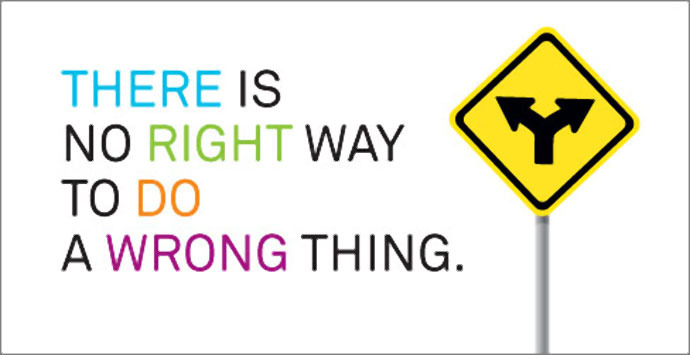
As PR students and hopeful practitioners, we are often taught the importance of being responsible and credible sources of information for our clients and media outlets. This isPicture1 especially significant given the unfortunate mistrust that has formed between the general public and major news publications given this new era of “fake news” in our country.

Yet, as students of this industry, we are also told the importance of representing our clients and brands to the best of our abilities, which may also include having to positively spin mishaps and lapses in judgement on their parts in a way that may not be completely honest.

As a result, when maintaining a client’s reputation conflicts with one’s own moral obligation to tell the whole truth and nothing but, how do we, as new members of this field, approach these difficult situations?

Much of the news coverage in 2018 centered on topics like the #MeToo movement, the Wells Fargo fake accounts fiasco, the alleged collusion between the Trump administration and Russia, and the Facebook data privacy scandal. What all of these issues have in common is that they stem from an overarching problem that we face in the U.S. where having a moral compass has fallen by the waste side and the boundary between what is ethically right or wrong has become blurred. And often, because of the sometimes unpleasant tasks that working in public relations and publicity require of us, we are tasked with cleaning up major social and political scandals that are becoming increasingly more frequent. Our job though, as students and therefore the future of this industry, is to focus on approaching our work with a new standard of ethics in mind. That way, we can maintain not only our credibility but also our reputation and morality as members of this field above all else.

We can strive to be more ethical PR practitioners in three major ways:

  1. By ensuring transparency. Rule #1 of being a good publicist across any PR specialty is to always be honest and transparent with one’s client—be it good news or bad. This transparency needs to carry over into said client’s interactions with consumers and the public as well. Sweeping things under the rug is only effective for so long and as history has proven time and again, these secrets will eventually be uncovered in time. So, to ensure your credibility and hire-ability as a PR personnel, you have to ensure both you and your client are transparent in your communications.
  2. Promoting accuracy. As mentioned previously, because we’re in the midst of an era in which some consumers are mistrustful of news outlets, it is our job to provide the public with accurate information and rise to the occasion of supplementing the information that people have previously gotten from watching/reading the news. So, now more than ever to avoid misunderstandings or miscommunications, we need to guarantee that every message we communicate, social media post we make, and fact sheet that we circulate is 100 percent factual and accurate.
  3. Bridging the gap between consumers and employees. The best way to ensure that we are being ethical in our practices is by forming an open dialogue with consumers. Rather than viewing them as some kind of faceless entity, and vice versa, we need to better understand who it is we are trying to market to, inform, etc., that way we can better appeal to their needs and hold ourselves more accountable for what we are sharing with individuals who are just like us. There should be open communication between employees and consumers so that we’re more socially aware of our audiences and the impact that we have on them in the decisions we make and the information we share or withhold. Once we bridge this gap, we can better understand how to build lasting trust with consumers and that, once this trust is broken, it cannot be re-earned. So, we need to be more morally aware of the consequences of certain unethical practices and the impact they have on the public as a result.

By focusing on how we can incorporate these three approaches to more ethical PR practices into our education, we can begin paving the way for a more successful and principled future in the industry that we so love.


Photo Source

How Poetry Led Me to Become a PR Student

Manuelita Maldonado, TriSight Contributor

I remember standing up in front of a rather small audience. As I read my speech, I nervously stared at the two men in front of me whose eyes were glued to the ceiling. Right next to them, a woman struggled to make eye contact with me while she counted the minutes until our break. The clock ticked. My tongue felt heavy, and my hands were sweating. My words were obscure, dense and incredibly boring. I wondered how I got there. Then I remembered: I was pretending to be a literature expert in a never-ending academic congress, and we all seemed to hate it.

Picture Manuelita Maldonado

Regardless of how much I loved reading and writing, I was unhappy with my literature major. I wanted to find a way to communicate with people at an emotional level, to engage them through exciting stories about the world. Writing long, indecipherable essays just wasn’t doing it. That’s when I found public relations.

I know my literature colleagues must be thinking I gave up my love for poetry and research, but I didn’t. As I dive more into the strategic communications world, I have started to realize how much my new professional life resembles what I learned in the past. Here is how my passion for novels and poetry intertwines with a career in public relations:

  1. Research
    I spent hours at my city’s local libraries trying to find out more information about how a novel was interpreted, or what kind of poems were being published at the time. Public relations works the same way. We must stay up-to-date with the latest news and know everything about our client, our customers, investors, and other stakeholders. Even though I don’t spend as much time in the library as I did before, I have spent a significant amount of time monitoring social media channels, reading press releases, looking for the most suitable influencers and bloggers, and finding trustworthy data about the market.

  2. Writing
    During four years, I wrote long academic essays on how literature became the utmost political tool in Latin America. Even though I found this topic incredibly interesting, my language was often hazy and abstract; and even my mom refused to read my papers. PR has allowed me to find simple yet accurate words to describe the world around me. I have learned to clarify and simplify complex topics by knowing my audience and using the right communication channel. Writing is still my daily bread, but now I am enjoying it with others.

  3. Storytelling
    As a literature student, I learned the power that lies behind a story. Novels like ‘1984’ for instance, were written to warn us about how dangerous and coercive modern-day governments can be. In PR, stories are the bridge that connects brands and organizations with their publics. Building strong, relatable narratives is a key component of the practice of public relations.

    I still think every communications practitioner should take the time to read a novel. Reading is a way to connect with other people’s thoughts, aspirations, and emotions: an exercise in empathy. This kind of empathy is the most important step in building genuine relations with our clients and customers.